=
Search

Fuel system

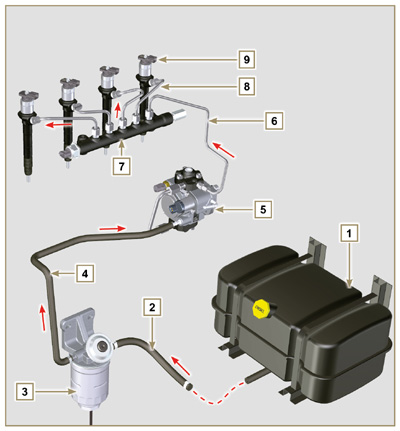
2.9.1 Injection circuit (pressure 2000 bar) (Fig 2.4)


The materials of the fuel system components (pipes, tank, filters, etc.) and any surface treatments must be free from chemical elements that, transported in the fuel, compromise the operation of the injectors over time (hole clogging).
The most critical chemical element is Zinc (Zn), therefore it is forbidden to use galvanised components.
Other damaging elements are indicated in the table below.


Tab 2.12

METALS LIMIT VALUES OF PRESENCE IN FUEL LIMIT VALUE
Zn (Zinc)
  • Zinc (Zn) is eluted from the rubber (NBR) in the fuel line. Thus, the growing carboxylate (Zn) was adhered on the parts in the injection system for reacting carboxylic acid in the fuel.
  • In case that the changed injection quantity, nozzle coking occurs the fuel contents Zn≥1ppm. 
  • Zinc (Zn) is ≤ 0.3ppm is the limited value to avoid occur coking.

Zn ≤ 0.3ppm

Pb (Lead)
  • Lead (Pb)is eluted from Pd coading in the fuel tank. Thus, the growing carboxylate (Pd) was adhered on the injection system for reacting carboxylic acid in the fuel.
  • In case that the changed injection quantity and nozzle coking occurs the fuel contents Pd.
  • As interim, the identical level is the limited value with Zn.

 Pd ≤ 0.3ppm

Na (Sodium)
  • The growing carboxylate (Na) was adhered on the parts in the injection system for reacting carboxylic acid in the fuel with fuel contents Na ≥ 0.5ppm. Thus, sliding malfunction was occurred.
  • In case that the changed injection quantity and nozzle coking occurs the fuel contents Na.
  • Especially concerns of occurring defects, NaOH is residue for using production process of bio fuel.
  • ≤ 0.3ppm is the limited value to avoid occur nozzle coking and carboxylate. Combine K with Na equivalent alkali metal that are less than 0.3ppm.

Na + K ≤ 0.3ppm

(Potassium)
Ca (Calcium)
  • In case that carboxylate (Ca) was adhered the injection system inside.
  • Under study on the results in the moment.
  • Maximum value is 0.3ppm when using fuel that is B100 fuel with regulation EN14214 of contents 7%.

 Ca + Mg ≤ 0.3ppm

Mg (Magnesium)
Cu (Copper)
  • Copper (Cu) on the fuel that can be acted wear and catalyst for making decline.
  • In case that the changed injector quantity and nozzle coking occurs in the fuel contents Cu.
  • As interim, the identical level is the limited value with Zn.

Cu ≤ 0.3ppm

Ba (Barium)
  • In case that changed injection quantity and nozzle coking occurs in the fuel contents Barium (Ba).
  • As interim, the identical level is the limited value with Zn.

Ba ≤ 0.3ppm

(Phosphorus)
  • Phosphorus (P) in the fuel can poison catalyst.
  • No failure case is in the injection system in the moment.
  • Maximum value is 0.3ppm when using a B100 fuel with regulation EN 14214 of contents 7%.

P ≤ 0.3ppm

Na - K - Ca - Mg - P

These metals are regulated in EN14214


  Important
  • The high pressure supply injection system is highly susceptible to damage if the fuel is contaminated.
  • It is crucial that all components of the injection circuit are thoroughly cleaned before the components are removed.
  • Thoroughly wash and clean the engine before maintenance.
  • Contamination in the injection system may cause a reduction in in performance or engine faults.
  • If the engine is cleaned with high pressure washer, then the nozzle must be kept at a minimum distance of 200mm from the surface, and not directed at electrical components and connectors.

The fuel supply system is under low pressure from fuel tank 1 to the high-pressure fuel injection pump 5.


NOTE: The representation of fuel tank is purely  indicative. Component not necessarily supplied by KOHLER.


Tab 2.13

POS. DESCRIPTION
1 Fuel tank
2 Fuel pipe under low pressure from the tank to the fuel filter
3 Fuel filter
4 Low-pressure fuel tube from the fuel filter to the high-pressure injection pump
5 High-pressure fuel injection pump
6 High-pressure fuel tube from the high-pressure fuel injection pump to the Common Rail
7 Common Rail
8 Fuel pipes under high pressure from the Common Rail to the electronic injectors
9 Electronic injectors

Fig 2.4

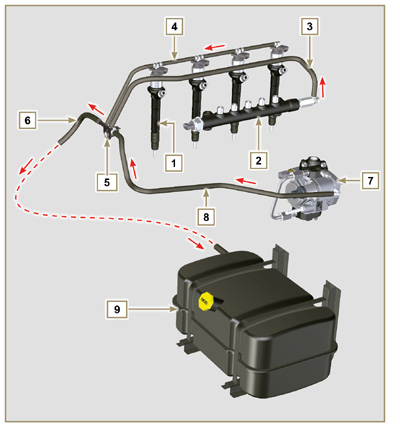
2.9.2 Fuel return circuit

The fuel return circuit is under low pressure.


NOTE: The representation of fuel tank is purely  indicative. Component not necessarily supplied by KOHLER.


Tab 2.14

POS. DESCRIPTION
1 Electronic injectors
2 Common Rail
3

Low-pressure fuel return tube from the Common Rail to the fuel return distributor

4 Low-pressure fuel return tube from the electronic injectors to the fuel return distributor
5 Low-pressure fuel return distributor
6 Low-pressure fuel return tube from the return distributor to the fuel tank
7 High-pressure fuel injection pump
8 Low-pressure fuel return tube from the injection pump to the fuel return distributor
9 Fuel tank

Fig 2.5

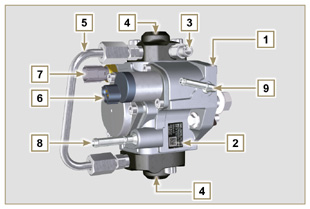
2.9.3 High-pressure injection pump (2000 bar)


  Important
  • DO NOT use the cylinder connecting pipe (item 5) to carry the pump during movement as this may cause damage resulting in fuel leakag; to handle the injection pump, refer  Par. 2.17.1.
  • The injection pump CANNOT be repaired.
  • DO NOT attempt to remove the temperature sensor 7 from the pump. Should the sensor 7 be defective, replace the injection pump.
  • It is NOT possible to perform any maintenance on the fuel intake regulating valve 6 as it is an integral part of the injection pump.
  • DO NOT attempt to remove the fuel intake regulating valve 6 from the injection pump. Should the valve be defective, replace the injection pump.

NOTE: In the event of leakage from the high pressure circuit do not intervene when the engine is running, but turn it off and wait 5 - 10 minutes before checking the leakage.


 The inlet pressure to the high pressure pump must be between 300 mbar (suction pump without electric supply) and 200 mbar (with electric pump power) to the high pressure rail.

The high pressure pump is operated via the pump control gear and sends high pressure fuel to the common rail.


NOTE: The supply tube (on union 8) and fuel return (on union 9), have different diameters.


Tab 2.15

POS. COMPONENTS DESCRIPTION
1 High-pressure fuel injection pump
2 Name plate with QR code
3 Fitting for high pressure outlet to Common Rail
4 Plunger housing
5 Connection pipe plunger housing
6 Fuel intake regulating valve
7 Fuel temperature sensor
8 Fuel inlet fitting
9 Fuel return fitting
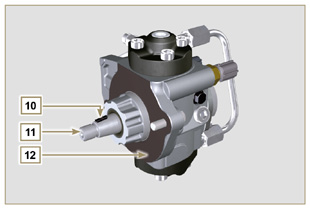
10 Shaft key positioning on the pump control gear
11 Pump control shaft
12 Gasket

Fig 2.6


Fig 2.7

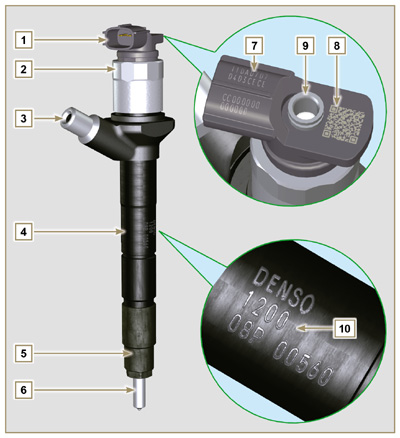
2.9.4 Electronic injector


The electronic injector is equipped with an integral solenoid valve which, when excited electronically, manages a valve controlled from
inside the electronic injector to commence fuel injection.

The ECU output signal is digital.

Important
  • The electronic injector is NOT repairable.
  • The electronic injectors are calibrated individually.
  • They are NOT interchangeable with the other cylinders of the same - or other - engines.
  • It is assembled on the engine; the new calibration code (QR code) must be inserted in the ECU by means of a diagnostics instrument (ST_01).
  • Do NOT fit new or different electronic injectors without the instruments required to enter the injector calibration code.
  • Fuel containing impurities causes serious damage to the electronic injectors.
  • The electronic injector for Stage V engines is different and it is not interchangeable with other engine

Fig 2.8

Tab 2.16
POS. COMPONENTS DESCRIPTION
1 Connector for solenoid control
2 Solenoid and valve closure ring
3 High pressure pipe inlet fitting
4 Electronic injectors body
5 Nozzle closure ring nut
6 Nozzle
7 QR code (Visual reading)
8 QR code (Electronic reading)
9 Return pipe fitting
10 Electronic injector identification code

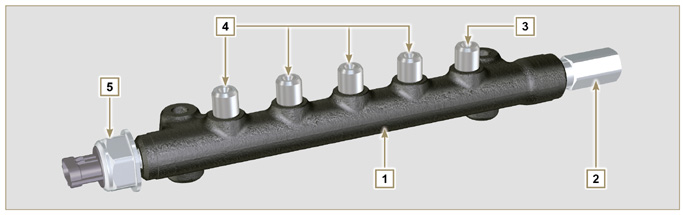
2.9.5 Common Rail


Fuel is injected under pressure into the Common Rail (Pos.3), from the high-pressure fuel injection pump.

  • The internal volume of the Common Rail is optimised to obtain the best compromise in order to minimise pressure peaks due to the cyclical flow of the injection pump;
  • Opening the electronic injectors;
  • The high speed response of the system to the requests of the ECU control unit.

The pressure sensor 5 measures the pressure of the fuel in the Common Rail.
Safety valve 2, only opens if internal pressure of the Common Rail exceeds the maximum value of 2400 bar.
Pressure inside the Common Rail is regulated by the highpressure fuel injection pump by means of the fuel intake regulation valve (Pos. 6 Fig. 2.6).

The fuel ejected from the safety valve is introduced in the circuit of rejection returning to the tank.


  Important
  • Common Rail is NOT reparaible.
  • It is NOT possible to perform any maintenance on the fuel pressure sensor 5, as it is an integral part of the Common Rail unit.
  • Do NOT remove the pressure sensor or the fuel pressure limit valve from the Common Rail.
  • If the pressure sensor or the pressure limit valve are not working, replace the entire Common Rail unit.


Fig 2.9

Tab 2.17

POS. DESCRIPTION
1 Common Rail
2 Pressure limit valve (return due to overpressure)
3 Tube inlet union from high-pressure fuel injection pump
4 Outlet fittings for supply pipes to electronic injectors
5 Fuel pressure sensor

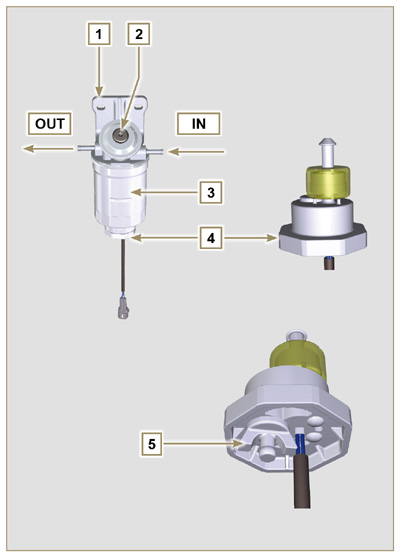
2.9.6 Fuel filter


The fuel filter is situated on the crankcase of the engine or it may be assembled on the frame of the vehicle.

Tab 2.18

POS. COMPONENTS DESCRIPTION
1 Fuel filter support
2 Fuel system filling button
3 Cartridge
4 Water in fuel sensor
5 Wing nut, filter drainage

Tab 2.19
DESCRIPTION VALUE
Filtering surface 2.300 cm2
Degree of filtration 5 µm
Max operating pressure 2.0 Bar
Max flow rate 190 litres/hour

Fig 2.10
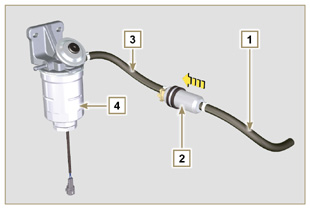
2.9.7 Electric fuel pump (optional)
When the electric fuel pump is installed in a diesel engine, one must:
  1. Remove any filters installed on the inlet of the electric injection pump;
  2. Insert a pre-filter between the tank and the electric pump;
  3. The electric pump may be assembled on application at a maximum height of 500 mm from the position of the fuel tank.
  4. Insert a shut-off valve to prevent dry operation due to the emptying of the intake manifold;
  5. The supply pressure given from the electric pump must not exceed the pressure of 0.2 bar to the input of highpressure injection pump.


Tab 2.20
POS. DESCRIPTION
1 Arrival pipe from the tank
2 Electric pump
3 Flow pipe to the fuel filter
4 Fuel filter


Fig 2.11


2.9.8 Guards for fuel injection circuit components


High-pressure injection circuit components are particularly sensitive to impurities.
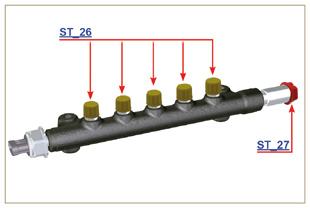
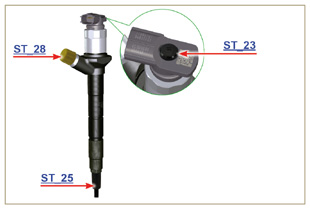
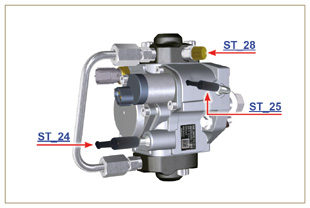
To prevent impurities, even microscopic ones, from accessing the fuel input or output unions, you are required to close these accesses by means of specific caps as soon as the various tubes are disassembled and disconnected.


Disassembly of any component of the injection circuit must not occur in dusty environments.


Cap protections must remain closed in their housing (ST_40) until the moment they are to be used.


Pay special attention when using the caps and avoid any contamination of dust or dirt of any kind.


Even after using the caps illustrated in this paragraph, all components of the injection circuit must be placed with care in environments that are free of any type of impurity.


Fig. 2.13, 2.14 and 2.15 illustrate the caps that must be used on components of the injection circuit.


Cap protections must be accurately washed after use and placed back in their housing (ST_40).


  Important
  • It is highly recommended to have this page visible during disassembly operations of the components of the fuel injection circuit.

Fig 2.13


Fig 2.14


Fig 2.15


Wait Loading