=
Search

Engine block assembly

9.2.1 Crankshaft bushings


Important
  • Execute the procedure in Par. 8.2.1 and 8.2.2, before proceeding with assembly..
  • The crankshaft half-bearings are made of special material. Therefore, they must be replaced every time they are assembled to prevent seizures.
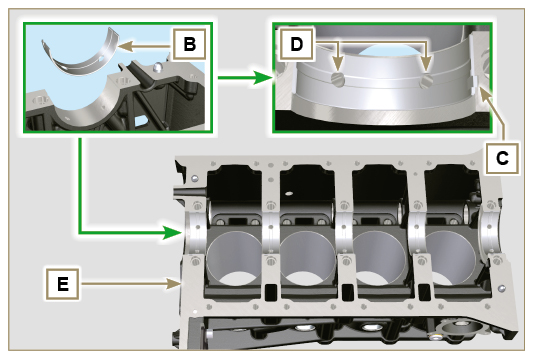
  1. Fit the new half-bearings B onto the crankcase upper half E adhering to the reference notches C.


Important
  • After the half-bearings are fitted, check that the lubrication holes D correspond with the crankcase grooves E.
  • The lower and upper half bearings CANNOT be singularly replaced, and both halves must be replaced together.


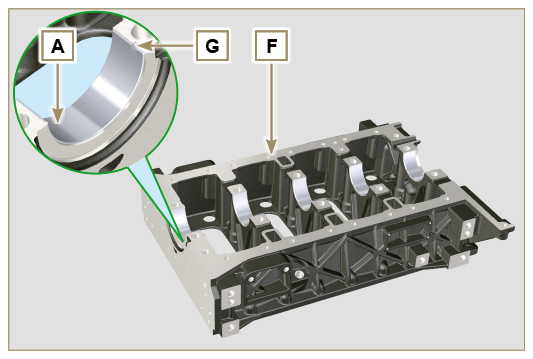
  1. Fit the new half-bearings A onto the lower crankcase F using the reference notches G.
  2. Lubricate the half-bearings A and B with oil.

Fig 9.1


Fig 9.2

9.2.2 Tappets


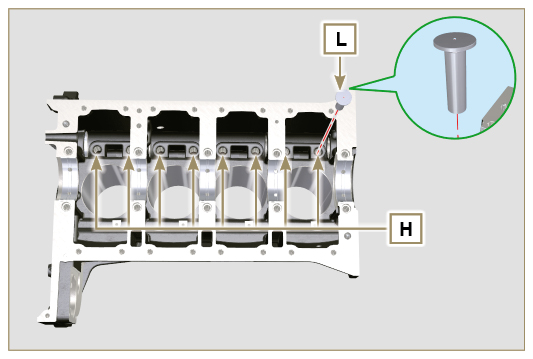
  1. Lubricate the tappets G with oil.
  2. Insert the tappets G into the housings H of the upper crankcase.

Fig 9.3

9.2.3 Camshaft


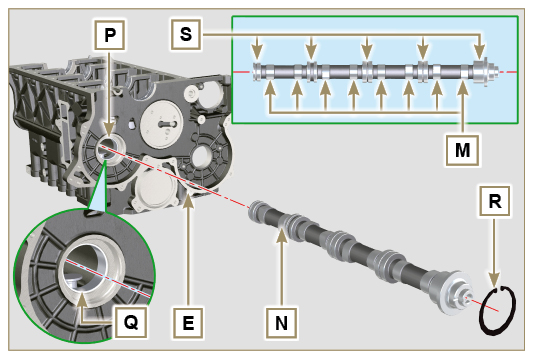
  1. Check that the bushing Q is correctly fitted.
  2. Lubricate the pins L, the cams M of the camshaft N, all the housing (Par. 8.2.4 or 8.2.6)and the bushing Q with oil.
  3. Insert the camshaft N all the way into its housing P.
  4. Fit the lock ring R on to the crankcase E to hold the position of the camshaft N.
  5. Manually rotate the camshaft N ensuring that it is free.

Fig 9.4

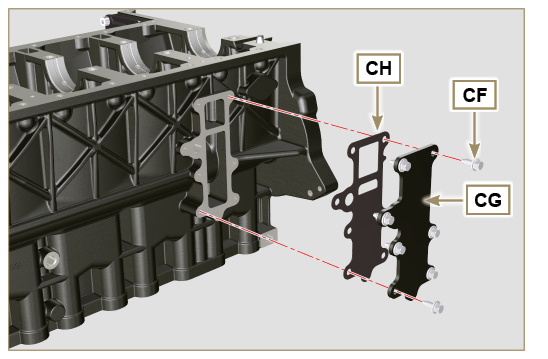
9.2.4 Vent compartment closure lid


  1. With the screws CF tighten the cover CG and the gasket CH (tightening torque to 10 Nm).

Fig 9.5

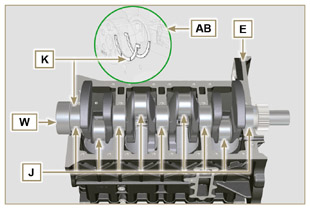
9.2.5 Crankshaft


Important

  1. Check that the crankshaft half-bearings are mounted correctly on the upper crankcase E.
  2. Lubricate the main journal and crankpin J, with oil.
  3. Insert the crankshaft W into its seat on the upper crankcase E.
  4. Insert the 2 shoulder half-rings K, between the crankshaft W and the upper crankcase E (AB detail).

Fig 9.6

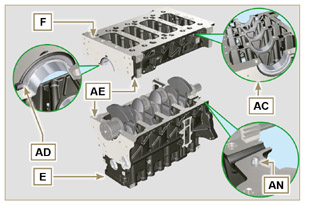
9.2.6 Lower crankcase


  1. Check that the crankshaft half-bearings are mounted correctly on the lower crankcase F (AC detail).
  2. Assemble the 2 shoulder half-rings AD onto the lower crankcase F applying two drops of oil to keep them in their seat.
  3. Check that the coupling surfaces AE are free from dirt and grit.

Fig 9.7
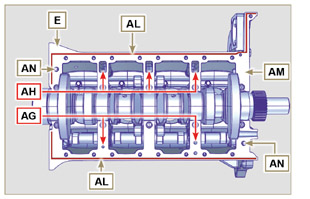
  1. Spread a bead of Loctite 5660 (rif. AL) of approx 1 mm thickness on the surface AM of the upper crankshaft half being careful not to block the oil feed grooves AG and the return oil sump AH.
  2. Join the two crankshaft halves E and F observing the guide pins AN.

Fig 9.8
Important
  • Failure to follow the bolting procedures compromises the functionality of the engine and can cause damage to people and property.

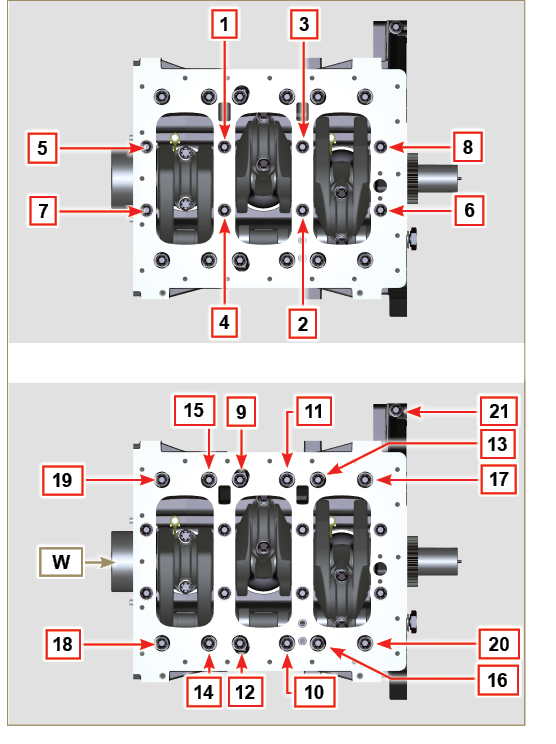
  1. Tighten the fastening screws strictly following the sequence and the tightening torque indicated.
    Tightening sequence for 3 cylinders
    Tightening Screws Torx M12x1,25 (from the n° 1 to the n° 8):
    CYCLE 1 - with a torque of 40 Nm;
    CYCLE 2 - with a torque of 70 Nm;
    CYCLE 3 - with a torque of 120 Nm.

    Tightening Screws Torx M8 (from the n° 9 to the n° 21):
    CYCLE 4 - with a torque of 20Nm;
    CYCLE 5 - with a torque of 35 Nm;
  2. Perform the operations described in Par. 8.4.2.
  3. Check that crankshaft W rotates smoothly.

NOTE: In the next illustrations of Par. 9.3 the coupled crankcase half will be indicated with the letter E.

 3 Cylinders

 
Fig 9.9

  1. Tightening sequence for 3 cylinders
    Tightening Screws Torx M12x1,25 (from the n° 1 to the n° 10):
    CYCLE 1 - with a torque of 40 Nm;
    CYCLE 2 - with a torque of 70 Nm;
    CYCLE 3 - with a torque of 120 Nm.

    Tightening Screws Torx M8 (from the n° 11 to the n° 27):
    CYCLE 4 - with a torque of 20Nm;
    CYCLE 5 - with a torque of 35 Nm;
  2. Perform the operations described in  Par. 8.4.2.
  3. Check that crankshaft W rotates smoothly.

4 Cylinders


Fig 9.10

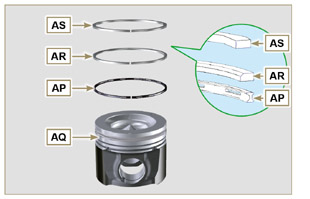
9.2.7 Piston rings


  1. Perform the operations described in Par. 8.5.3.
  2. Put the scraper ring AP onto the piston AQ.
  3. Put the 2° seal ring AR on the piston AQ.
  4. Put the 1° seal ring AS onto the piston AQ.

Fig 9.11
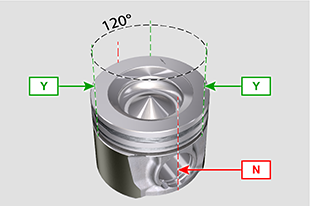
  1. Perform the operations described in Par. 8.5.4.
  2. Position the segment openings with a 120° angle between them (Y).


NOTE: do not use the segment opening with the pin hole (N)


  1. Lubricate the piston skirt and piston rings with oil.

Fig 9.12

9.2.8 Piston and connecting rod


Important
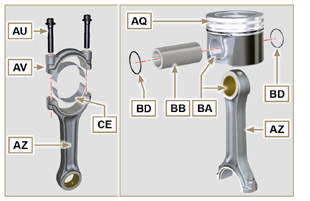
  • Before proceeding to the assembly of the piston and connecting rod, carry out the checks described in Par. 8.5.1.
  • Always replace the bearings CE after each assembly.

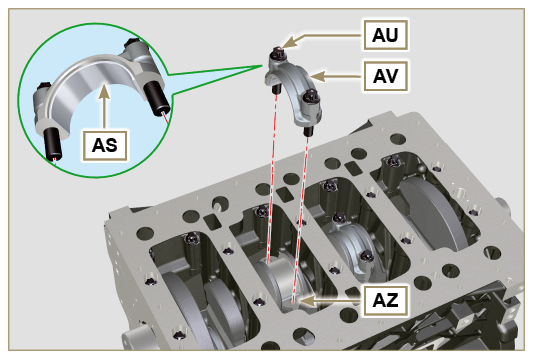
  1. Loosen the screws AU and remove the connecting rod cap AV.
  2. Fit the new bearings CE.
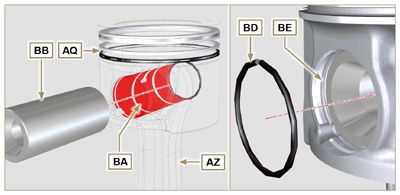
  3. Insert the connecting rod AZ into the piston AQ and align the seats BA.
  4. Insert the gudgeon pin BB into the seat BA for the assembly of the connecting rod and piston unit.
  5. Insert the lock rings BD inside the seat BE of the piston AQ to lock the gudgeon pin BB.

Fig 9.13


Fig 9.14

9.2.9 Piston and connecting rod assembly


 Important
  • Before assembling the piston and connecting rod assemblies, execute the controls described in Par. 8.5


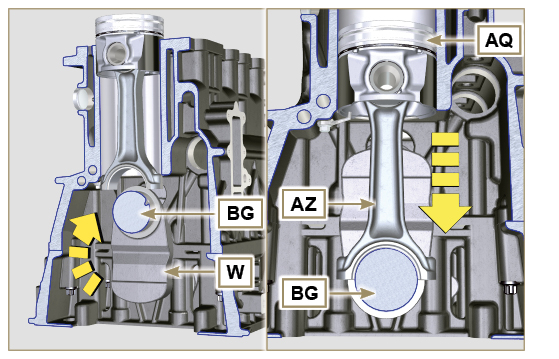
  1. Rotate the crankshaft W by moving the crankpin BG to a TDC position of the affected cylinder.
  2. Push the piston AQ downwards by centering the crankpin BG with the connecting rod AZ.
  3. Turn the crankshaft on support to assemble the con rod capp on cylinder 1 and 4. 

Fig 9.15
  1. Check that the half-bearing AS is mounted correctly on the connecting rod cap AV.

Important
  • As the rods are divided by breaking pay particular attention to the coupling of the cap on the connecting rod.
  • Check before you screw and tighten the bolts that the breaking surfaces are perfectly flush.


  1. Couple the connecting rod cap AV to the connecting rod AZ using the marks made at disassembly (Par. 7.13.2)
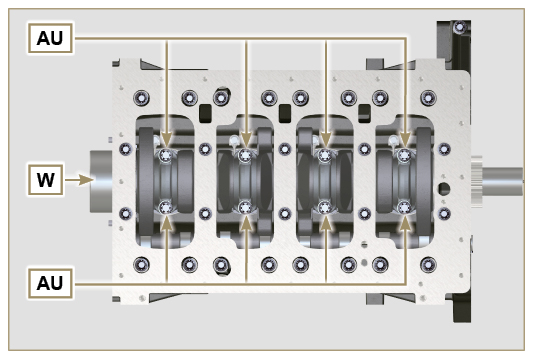
  2. Screw in the screws AU.
  3. Repeat the operations from 1 to 6 for the cylinders 2 and 3.

Fig 9.16

  Important
  • Failure to follow the assembly procedures compromises the functionality of the engine and can cause damage to people and property.


  1. Tighten the screws AU, alternately, strictly following the tightening torques indicated.

    Tightening sequence of screws Torx M10x1:

    1° PHASE - with a torque of 40 Nm;
    2° PHASE - with a torque of 85 Nm;

  2. Check that the connecting rods have axial play and the crankshaft W rotates smoothly.

NOTE: After the check carried out at point 8, position the shaft W with the first cylinder to TDC.

Fig 9.17

9.2.10 Crankshaft gasket flange

 
Important
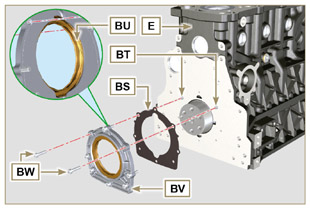
  • Check that the contact surface between the flange and the crankcase is free of grit and dirt.
  • Always replace the gasket BS after each assembly.

  1. Check that there are bushings BT on the crankcase E.
  2. Lubricate the oil seal lip BU.
  3. Position the gasket BS and flange BV on the crankcase E in correspondence with the bushings BT.
  4. Put Loctite 243 on the 2 screws BW matching the bushings BT.
  5. Screw the fastening screws all the way in BW without tightening them.
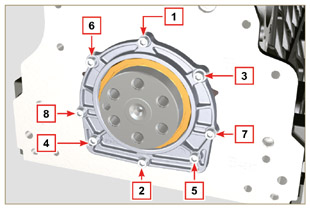
  6. Tighten all the screws BW strictly following the tightening sequence indicated (tightening torque to 10 Nm).

Fig 9.18


Fig 9.19

9.2.11 Flange 3rd PTO


Important
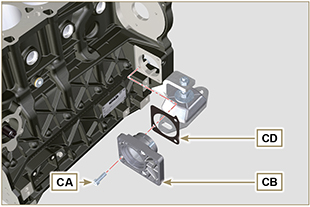
  • Replace capscrews CA with each assembly or alternatively apply Loctite 2701 on the thread.


  1. Secure the cover CB with the screws CA and CC inserting the gasket CD (tightening torque 25 Nm).

Fig 9.20


Wait Loading